
Slide 1

Serving South Florida

Slide 2
For over 40 years

Interior Design

Life After COVID-19? How Interior Design will Change
Covid Interior Design Trends for Homes
Spending months in quarantine has already dramatically impacted design, with new trends that will undoubtedly continue to resonate well into 2021 and beyond. The future of interior design will reflect the reality of a world that has been forever changed by incorporating cleanliness and materials to help to mitigate the spread of disease, floor plans that provide separate spaces for home-bound activities, and a focus on personal well-being.
Nature-starved homeowners have been craving what they’ve been denied of late, so expect to see an increased number of plants and lush indoor gardens, earth-toned color schemes, outdoor-style interior flooring, and even the occasional attached greenhouse.
Residences will no longer have a home office, but an office at home. Significant reconsideration of how we can create a beautiful, functional office at home will be designed and set up to accommodate full time satellite workplaces.
If you’re doing your part and social distancing from inside your home, you may start to notice small details of your house or apartment you hadn’t thought about before – like how to help keep your home as clean as possible during the corona virus outbreak. There are few materials that we can use that are more sterile than others and will be used even more in the future of design.
        • Metals such as copper, brasses, and bronzes are natural antimicrobial materials that have intrinsic properties to destroy a wide range of microorganisms. Not only are these metals hygienic, but they are great accents to warm up your home.
        • A separate “casita” or guest house suite can be useful for isolating someone that may be ill, or to provide more distance and privacy for guests.
        •  Office spaces and study areas are more necessary than ever. As more of us work (and learn) from home, a dedicated office and space for studying is essential. Many of us quickly had to convert areas and rooms to our own home offices – showing us the importance of a separate space. Homes with multiple areas for getting work done – offices, libraries, and study areas – will be even more popular in design.
        • Multiple areas for activities and entertainment, such as home gyms, media rooms, and game rooms will be necessary to keep everyone entertained. During this pandemic, we have found ourselves with a lot of time on our hands, so whether it’s a family game night or a workout, the need for a space for everyone at home has only increased.
        • There’s no doubt that the future of kitchen design will look different in a post COVID 19 world. First, we have been forced to alter the way we shop, store, and prepare food. Second, we have more time at home to get organized, tackle lingering projects, and sanitize our homes. Finally, we have had to change the way we interact and socialize with family, friends, and colleagues. More long term storage and larger freezer capacity are in demand. New kitchens will be designed with cleanability in mind. Low maintenance cabinet finishes, faucets, tile, and fixtures will be a top priority. Quartz is one of the hardest non-precious stones on earth, therefore countertops made from quartz are hard, stain and scratch-resistant, and the most sanitary.

Our living spaces greatly influence our physical health – as well as our emotional state of mind (especially during his time). So it will continue to be important to create environments that stimulate our senses in a good way, improve relaxation, and have health and wellness benefits to the people using them. Here are a few ways of living that will be popular.

  • Bringing in nature will be emphasized in many different ways. From larger windows with views outside and using colors that reflect the natural world. Having lots of greenery in a home is also an obvious and easy stimulant to our overall wellbeing (along with lots of health benefits).
  • An increase in organization. Being quarantined at home makes us realize what is really necessary. Clutter can cause anxiety and discomfort – feelings that are more unwanted than ever. Organization will be emphasized, through de-cluttering, smart storage, and built-in shelving and spaces for keeping items organized in smaller spaces.
  • A sense of security and calm will definitely be present in interiors. When the world is full of uncertainty, having a space that feels like an escape from the outside world, with soft and cozy materials, light colors and relaxing vibes, will be a prerequisite of design.

When it comes to colors this year, we’re seeing the return of earth tones in a wide spectrum, from cream to terra cotta.  Expect to see decor that conveys softness, with plenty of light colors, especially pinks, beiges and other neutral tones, for a Zen look promoting rest, tranquility and well-being.

Nature continues its influential role in the world of decor. Vegetal hues have been in the spotlight for several seasons now, and this year we saw a lot of them, ranging from tender green to intense mint to peacock blue. Sky blue has brightened up the pastel palette.

Earth tones aren’t the only trend with staying power of late. While black is becoming less popular, blue has been replacing it. It’s a more versatile and emotionally indulgent hue well suited to sheltering at home.

How to Arrange Furniture- 10 Basic Rules

Furniture Arranging
Furniture Arranging
Planning the arrangement of furniture is hard enough when you are buying new furniture to fill a house for the first time. It becomes even more challenging when you are moving a houseful of furniture from an existing home into a new space. It may take a while to get a feel for the new space and figure out how to make the rooms both comfortable and functional. And you need to be ready to rearrange, get rid of pieces that don’t fit, and perhaps purchase new items that might work a little better than your old pieces.
If possible, give careful consideration to the arrangement of furniture in the new space well before you move. This advance planning can make the arrangement go much smoother when moving day comes, and it might even prevent you from moving furniture that is not going to work in the new space, anyway. If a couch is destined to be given or thrown away, why go through the labor and expense of moving it from the old house to the new?
Over the years, interior designers have recognized a number of simple, easy-to-apply principles that work. Just follow these common sense rules and you’ll find that arranging furniture isn’t so scary after all.
1. Think About How the Room Will Function
Consider how the room is used and how many people will use it. That will dictate the type of  furnishings you will need and the amount of seating required.
2. Decide on a Focal Point
Identify the room’s focal point — a fireplace, view, television — and orient the furniture accordingly. If you plan to watch television in the room, the ideal distance between the set and the seating is three times the size of the screen (measured diagonally). Therefore, if you’ve got a 40-inch set, your chair should be 120 inches away.
3. Start With Priority Pieces
Place the largest pieces of furniture first, such as the sofa in the living room or the bed in the bedroom. In most cases this piece should face the room’s focal point. Chairs should be no more than 8 feet apart to facilitate conversation. Unless your room is especially small, avoid pushing all the furniture against the walls.
4. Consider Symmetry 
Symmetrical arrangements work best for formal rooms. Asymmetrical arrangements make a room feel more casual.
5. Create a Traffic Flow
Think about the flow of traffic through the room — generally the path between doorways. Don’t block that path with any large pieces of furniture if you can avoid it. Allow 30 to 48 inches of width for major traffic routes and a minimum of 24 inches of width for minor ones.
Try to direct traffic around a seating group, not through the middle of it. If traffic cuts through the middle of the room, consider creating two small seating areas instead of one large one.
6. Aim for Variety
Vary the size of furniture pieces throughout the room, so your eyes move up and down as you scan the space. Balance a large or tall item by placing another piece of similar height across the room from it (or use art to replicate the scale). Avoid putting two tall pieces next to each other.
7. Build in Contrast
Combine straight and curved lines for contrast. If the furniture is modern and linear, throw in a round table for contrast. If the furniture is curvy, mix in an angular piece. Similarly, pair solids with voids: Combine a leggy chair with a solid side table, and a solid chair with a leggy table.
8. Design for Ease of Use
Place a table within easy reach of every seat, being sure to combine pieces of similar scale, and make sure every reading chair has an accompanying lamp. Coffee tables should be located 14 to 18 inches from a sofa to provide sufficient legroom.
9. Allow for Circulation
In a dining room, make sure there’s at least 48 inches between each edge of the table and the nearest wall or piece of furniture. If traffic doesn’t pass behind the chairs on one side of the table, 36 inches should suffice.
In bedrooms, allow at least 24 inches between the side of the bed and a wall, and at least 36 inches between the bed and a swinging door.
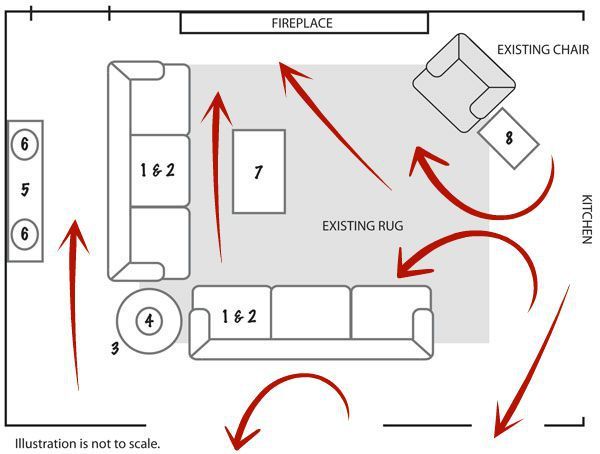
10. Do Your Planning 
Give your back a break. Before you move any furniture, test your design on paper. Measure the room’s dimensions, noting the location of windows, doors, heat registers and electrical outlets, then draw up a floor plan on graph paper using cutouts to represent the furnishings. Or, better yet, use a digital room planner to draw the space and test various furniture configurations. It’s less work and a lot more fun.