
Slide 1

Serving South Florida

Slide 2
For over 40 years

House Closings

Housing Starts Heating Up!

New Construction Assistance
Housing Starts and consumer inflation heated up in January, but Retail Sales and Existing Home Sales stayed on the chilly side.

The Commerce Department reported that January Housing Starts jumped 9.7 percent from December to an annual rate of 1.326 million units. This was the highest level since October 2016 and up 7.3 percent from January 2017. Single-family starts, which account for the largest share of the market, rose 3.7 percent from December while multi-dwelling starts with five or more units surged 19.7 percent. Housing Starts rose in the Northeast, South and West but declined in the Midwest.

Building Permits, a sign of future construction, rose 7.4 percent from December to an annual rate of 1.396 million units. With many buyers facing inventory shortages across much of the country, this strong report regarding new home construction is a welcome sign!

The National Association of REALTORS® reported that January Existing Home Sales declined 3.2 percent from December to an annual rate of 5.38 million units. Sales were down 4.8 percent from a year ago, the largest decline since August 2014. Low inventories of homes for sale were indeed a thorn in the side of would-be buyers with just a 3.4-month supply available at the current sales pace. A 6-month supply is considered healthy.

Retail Sales also disappointed in January, as the Commerce Department reported a 0.3 percent decrease. December’s reading was also revised downward to 0 percent from a 0.4 percent increase. The key highlight was that consumer spending wasn’t strong in recent months, and this could impact GDP expectations.

Consumer inflation edged higher in January, with an important component jumping to a 12-month high! The Consumer Price Index (CPI) rose 0.5 percent in January, just above expectations due to higher gasoline prices, the Labor Department reported. Core CPI, which strips out volatile food and energy prices, rose 0.3 percent from December. This was the largest increase in a year, boosted by rising rents.

Inflation reduces the value of fixed investments like Mortgage Bonds. This means signs of inflation can hurt Mortgage Bonds and impact the home loan rates tied to them, which is a trend we’ve seen through much of this year. Stocks have also reacted negatively to hints that inflation was on the rise because inflation brings higher rates and higher rates hurt corporate borrowing. Stocks even entered correction territory in early February, meaning a 10 percent decline from recent highs.

Tips for Investors New to Flipping

Flipping is when real estate investors buy real estate and then resells them at a profit months down the road. Can you make money doing this? Yes.

Can you make a lot of money doing this? Yes.

But you can also lose everything you own if you make a bad decision….Absolutely!

A renovation can be an overwhelming experience with high stakes. Investors must create an overall vision for the project, gauge its financial feasibility, build a reliable team that includes a Realtor, contractors, lender, accountant, insurance agent, designer or architect, and attorney or Title Company, be highly capitalized, and hope that their assessment of the market is accurate and that the property sells quickly. The longer your cash is tied up and you are paying expenses the less profitable your investment.

Thanks to tighter lending standards you will need plenty of cash, and nerves of steel, to get into flipping. So what do you need to get started?

  • First, you need an excellent credit score. Lenders have tightened their requirements for home loans, especially if you want a loan for a high-risk house flip.
  • You need CASH! Use the cash for a down payment, so you don’t have to pay private mortgage insurance (PMI) on your second mortgage. You could also take out a home equity line of credit (HELOC), if you qualify. If you have enough in savings, and you manage to find a bargain-priced property, you can buy the property for cash, and take out a small loan or line of credit to pay for the renovations, Realtor fees, and closing costs.
  • A great way to get started flipping houses – especially if you have little money – is to form a joint venture with a partner who has money. If you don’t have the money, the joint venture partner will fund the deal while you do all the work. Although you may not get rich on your first deal, you’ll gain something even more valuable – experience.

What Makes a Good Real Estate Investment?

Finding an undervalued property in this market can be a challenge. With foreclosure rates down and bank owned property inventory drying up, there is a shortage of inventory compared to just a year ago.  Utilizing real estate professionals will greatly assist you in finding suitable properties.


  • Location. Expert flippers can’t stress this enough. Find a home in a desirable neighborhood, or in a city where people want to live. Start by researching local cities and neighborhoods. Look for areas with rising real estate sales, employment growth, and good schools.
  • Sound Condition. You don’t want to tear the house down, and start rebuilding it from scratch. Look for structurally sound homes. You may not have the opportunity to have a home inspected, especially if you buy the home at a real estate auction. You need to learn what to look for, or bring someone knowledgeable about building, electric, and plumbing with you to look at the home, to determine if the home is structurally sound.
  • The Right Fixes. A home with old carpet and wallpaper may be easy, and cheap, to update. Other home repairs to tackle might include, replacing outdated kitchen and bathrooms, and replacing windows and doors. A house that has mold, needs a roof replacement, or needs rewiring, requires some serious time and cash to update and sell. Make sure you know which updates and repairs you can afford to fix, which repairs you can’t afford, and which home improvements will increase the selling price of the house. When you estimate the cost of any job, experts advise that you add 20% to the final estimate. Why? It’s always going to cost more than you think it will.
  • Value. Make sure the price of the home is below its value in the local market. Otherwise, you will not make money. The worst house in a great neighborhood has nowhere to go but up in value, due to the value of the other homes in the area. Know which home improvements increase the home’s value. Focus on these projects first. Home improvements that increase the value of a home might include upgrading kitchen appliances, repainting the home’s exteriors, installing additional closet storage space, upgrading the deck, replacing windows and doors.
  • Before you make an offer, make sure you know the uppermost price you can pay for a house, and still make a profit. This includes your estimate for repairs, interest, and taxes. Remember to pad your estimate by 20%. If the homeowner or bank won’t sell to you for this price, walk away. It’s better to keep looking, than to risk going broke from a bad investment.


Now Get Working

  • Make sure you know which home improvement projects you can complete quickly and successfully, and which projects will need contractors.
  • You need permits before you start remodeling. Not having the right permits, or not correctly displaying permits, can cause serious delays, and fines, from city inspectors. Make sure to apply for permits as soon as the sale is final. It’s also helpful to make a timeline for projects, with associated deadlines, and the budget listed for each project. This helps you, and your contractors, get renovations done quickly, and within budget.


Relist and Sell

  • Many flippers end up listing their homes with a Realtor. Realtors eat and sleep real estate, have access to buyers, and can list your house in the MLS database. They also know the current market fluctuations, and have the skills and network to get you the best price quickly.


Final Word

  • Without a doubt, flipping homes offer great risks, and great rewards. A house flipper must be prepared for the possibility that the home won’t sell right away. House flippers also have to make tough decisions, like whether to accept an offer that is less than they wanted, but still for a profit. If you can handle all of the ups and downs, and you have the time and enthusiasm for fixing up and selling homes, then house flipping might be right for you.


Mortgage Rates and The Fed

The Federal Reserve kept the benchmark rate unchanged on September 21st, in a divided vote that alludes to the possibility of a hike before the end of the year.

“The Committee judges that the case for an increase in the federal funds rate has strengthened but decided, for the time being, to wait for further evidence of continued progress toward its objectives,” the Federal Open Market Committee (FOMC) released in statement. “The Committee expects that economic conditions will evolve in a manner that will warrant only gradual increases in the federal funds rate; the federal funds rate is likely to remain, for some time, below levels that are expected to prevail in the longer run.”

“Our decision does not reflect a lack of confidence in the economy,” Fed Chair Janet Yellen said in a press conference, later adding, “We’re generally pleased with how the U.S. economy is doing.”Today’s action was largely expected by analysts as policymakers stood fast this summer, despite initially forecasting four hikes this year. The federal funds rate informs the trajectory of mortgage rates, which remain at historic lows.

Perhaps no sector has benefited more from ultra-low rates than housing, which was devastated by the real estate crash. Home sales are expected to total about 5.7 million this year, up from 5.4 million in 2014 and 4.6 million in 2011. The recovery can at least partly be traced to 30-year fixed mortgage rates that remain below 4%, down from about 6% in 2008, keeping borrowing costs low for buyers.

But today’s housing market is supported by far more than low mortgage rates — namely steady job and economic growth. What’s more, 30-year mortgages are priced off 10-year Treasury note yields, which do rise as short-term rates climb, but not as steeply.

Doug Duncan, chief economist of Fannie Mae, the giant government-sponsored funder of mortgages, expects this week’s Fed hike of a quarter of a percentage point to have virtually no immediate impact on Treasury or mortgage rates, noting markets already have priced in the move. Assuming the Fed raises its rate by a percentage point over the next year, Duncan expects 30-year mortgage rates to drift from 3.9% to 4.1% during the period. That would boost the monthly cost of a typical $225,000 mortgage by $26 to $1,454 — not enough to deter most buyers.

Adjustable-rate mortgages, many of which are modified annually, could increase about twice as rapidly, by about a half a percentage point. Yet as long as job growth and aggregate U.S. incomes increase proportionally, Duncan expects any market impact to be modest. A far bigger restraint on home sales, he says, is a limited supply that should push up prices by nearly 5% both this year and in 2016. As a result, Duncan expects home sales to increase 4% in 2016, down from 8% this year, with higher rates holding back 1% to 2% of deals.

“As long as the rate rise is gradual, I don’t see it as a hugely important factor,” he says.

Common Fees When Buying A Home

When buying a home, most people focus on how much the home costs and what interest rate they can get on the loan. While understanding the lending process is very important, the other fees that home buyers overlook when it comes to their home purchase.

There are some fees that will require up-front payment. Other fees may be rolled into the loan for your home. It’s important to understand the difference and know what you’ll be expected to pay.

Earnest Money Deposit

To prove you’re “earnest” in your purchase commitment, a buyer can expect to deposit to a trust account 1% to 2% of the total purchase price as an earnest money deposit within days of entering into a contract.This amount can change depending on market factors. If demand in your area is high, a seller could expect a larger deposit. If the market is cold, a seller could be happy with less than 1%.

Other governing factors like state limitations and rules can cap how much earnest money a seller can ask for.

Escrow account

An escrow account is basically a way for your mortgage company to make sure you have enough money to cover related taxes, insurance and possibly mortgage insurance. The amount you need to pay varies by location, lender, and loan type. It could cover costs for a few months to a year.

If you only provide a small down payment, you may be required to purchase private mortgage insurance. Private mortgage insurance, commonly referred to as PMI, is typically provided by a private mortgage insurance company to protect lenders against loss if a borrower defaults.

Sometimes this means you are required to pay a full year’s worth at time of purchase, or it will be rolled into your monthly payment.

Escrow accounts are common for loans with less than a 20% down payment and mandatory for FHA loans, but it’s not required for VA loans.

Origination Fees & Points

The origination fee is the price you pay the loan officer or broker for completing the loan, and it includes underwriting, originating, and processing costs.

The origination fee is a small percentage of the total loan. A typical origination fee is about 1%, but it can vary. You should shop lenders for more than interest rate, but all of the fees associated with the loan.

Inspections

You want to be assured your new home is structurally sound and free of defects before you complete the purchase. Those assurances come with a price.

  • Home inspection: This is critical for homebuyers. A good inspector will be able to notify you of structural problems, defective applianes, leaks, and other potentially serious problems. Expect to pay $300 to $800 for a home inspection, although cost varies by location and the size of the home and how many stories it is.
  • Radon inspection: An EPA-recommended step, this inspection will determine whether your prospective home has elevated levels of the cancer-causing agent radon. A professional radon inspection can cost several hundred dollars.
  • Pest inspections: Roaches are one thing. Termites or wood fungus are a whole different story. Expect to pay up to $150 for a Wood Destroying Organism inspection.

Attorney

Some states, such as North Carolina, require an attorney to be present at closing. In other states, such as Florida, this is optional. If you use a lawyer, expect to cover the costs, which vary by area and lawyer and what the attorney is being asked to do.

Credit check

Just because you can get your credit report for free doesn’t mean your lender can (and they will actually pull all three). You have to reimburse the lender, usually around for these reports that usually run about $30.

Insurance

If you live in a hazard-prone area, you might need to purchase extra insurance in addition to homeowners insurance, these can include wind and flood. Lenders will require that you purchase the required insurance to protect their investment. If you are a cash buyer, you have the option of buying insurance or self-insuring. Make sure you understand the risks.

Appraisal

Your lender will not approve a loan for a home without knowing what its fair market value is. They will determine this value based on an appraisal.  Appraisal costs vary by market area and the size and complexity of the property. An appraisal will typically cost $250 to $1000.


Title Insurance

Title insurance covers you in the unlikely case that the person who sold you the house didn’t actually own it or if information on the title was false. Typically this is verified before the purchase of your home, but this insurance protects the lender or the buyer against loss arising from disputes over ownership of a property.

The lender will require you to have title insurance for the value of the loan. You are also required to have title insurance on the value of the property. Whether the buyer or seller pays for this is area specific and is a protocol not a mandate and can be negotiated as a condition of the contract.

Survey

A survey is not required in all instances, but your lender may require a professional surveyor to determine exactly where your property lines are drawn. Your attorney will also review the survey to ensure that there are no encroachments. Prices vary widely, but expect to pay at least $100.

Document preparation fees:

The lender, broker, Title Company or closing attorney will usually have a fee to cover the preparation of the required documents for the loan and closing paperwork. These fees are typically rolled in closing costs for the home and may be covered by either the homebuyer or seller.


State Recording Fees:

Depending on where you live, there may be a fee required for recording and holding the information regarding the sale.

Ensure A Smooth Mortgage Application Process

What to do before closing:

  • You can still be denied for a mortgage loan, even after you’ve been pre-approved by the lender. The pre-approval is not a commitment or guarantee. You’ve been conditionally qualified for loan. But you need to stay qualified all the way up to the closing. The less your financial situation changes, the better.
  • If you withdraw or transfer funds for any reason before closing, your lender will probably ask for a written explanation. They will also want to see a record of the transaction, such as your bank statements.
  • Make sure you have a home owners insurance policy in place. Your lender will require this. They might even require you to pay the first year’s premium in advance, by setting up an escrow account. The lender may contact your insurance agent before closing day, to verify the policy and coverage amount.
  • If you make any large deposits into your account, tell your lender about it. It will only help your cause, as far as mortgage approval goes. Provide any documents you have relating to the deposit.


What to avoid before closing day:

  • Don’t spend a lot of money. Implement a self-imposed “spending freeze,” as much as possible. You obviously have to buy groceries, gas for your car, and other necessities. But don’t spend anything beyond that. Keep things as stable as possible until after you close on the home.
  • It’s best to avoid any major purchases during this period. Your lender might have certain cash-reserve requirements for the loan. So a major reduction in assets could hurt your chances of getting the final approval.
  • Don’t open any new credit lines, such as credit cards. The same goes for buying a car, applying for a store credit card, etc. These things will change your debt ratio, which could cause problems with your final approval. Mortgage lenders hate surprises.
  • Don’t switch jobs before closing, unless it’s completely unavoidable. A new job usually brings a change in income, as well. If your income goes down, it will alter your debt-to-income ratio in a bad way. A change in employment will also require a lot of paperwork changes. Some lenders will verify your employment again, just before closing day.


Florida’s Housing market: Rising Prices In June

Florida’s housing market reported higher median prices and fewer days to a contract in June, according to the latest housing data released by Florida Realtors®. Closed sales of single-family homes statewide totaled 27,086 last month – slightly higher (0.4%) than the June 2015 level of 26,973 closed sales.

“Florida’s housing market is experiencing tight supply and pent-up demand.  That is affecting the pace of sales and putting pressure on statewide median prices. Florida’s economic growth, rising jobs outlook and acclaimed quality of life continue to draw new residents eager to call the Sunshine State home.

Home sellers continued to get more of their original asking price at the closing table in June: Sellers of existing single-family homes received 96.3 percent (median percentage) of their original listing price, while those selling townhouse-condo properties received 94.6 percent (median percentage).

The statewide median sales price for single-family existing homes last month was $225,000, up 10.8 percent from the previous year, according to data from Florida Realtors research department in partnership with local Realtor boards/associations. The statewide median price for townhouse-condo properties in June was $164,000, up 8.6 percent over the year-ago figure.

In June, statewide median sales prices for both single-family homes and townhouse-condo properties rose year-over-year for the 55th month in a row.  According to the National Association of Realtors®(NAR), the national median sales price for existing single-family homes in May 2016 was $241,000, up 4.6 percent from the previous year the national median existing condo price was $229,600.  In California, the statewide median sales price for single-family existing homes in May was $518,760; in Massachusetts, it was $353,000; in Maryland, it was $282,257; and in New York, it was $212,500.

Short sales for townhouse-condo properties declined 43.2 percent while short sales for single-family homes dropped 37.2 percent. Closed sales may occur from 30- to 90-plus days after sales contracts are written.

“Much of 2016’s slowdown in sales growth is due to the dwindling inventory of distressed properties throughout Florida,” said Florida Realtors® Chief Economist Brad O’Connor. “In June of last year, about 20 percent of sales across all property types were of the distressed variety. This June, by contrast, only 10 percent of sales were distressed. These declines are not due a lack of demand, but rather, a clear lack of supply. Florida’s distressed properties continue to slowly but surely work their way through the pipeline.

“If distressed properties are taken out of the equation, sales growth among non-distressed properties – the traditional market – remains quite strong. Non-distressed single-family home sales were up 13 percent year-over-year in June, while non-distressed sales of townhouses and condos rose by 7.6 percent.”

Inventory was at a 4.3-months’ supply in June for single-family homes and at a 6-months’ supply for townhouse-condo properties, according to Florida Realtors.

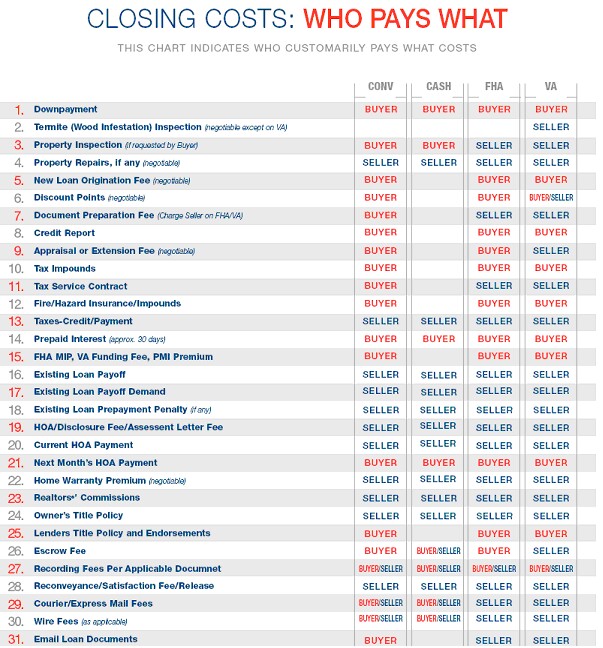
Typical Closing Cost: Who Pays What?

Closings-Costs-Chart

This chart is a representation of the standard real estate closings.  Different rules may apply by State or county within a State.

Most Often Asked Homebuyer Questions – Answered!  

Buying a home is a major lifestyle and investment decision. Homebuyers have a lot of questions throughout every step of the process and I have found that many of the questions are common to many. Here are some answers to the most common questions I get asked.

Q: What home can I afford?

That depends, of course-on your income and other financial obligations. There are many Home Affordability Calculators for a ballpark figure. A visit to the Optima Properties website will offer you many tools under the  Finance Center!

Before you start to shop, make sure that you know exactly what you can afford by getting pre-qualified by your financial institution of mortgage broker.

Q: Can I buy a home and sell my current one at the same time?

Yes, you can-but it’s the real estate equivalent of walking a tightrope. This is one of the trickiest questions to answer, on the one hand, if you buy a home before you sell the one you’re in, you’re overextended financially; if you sell before you buy, you might need to rent a while before finding a new place. There are ways to do both at once, and one option is to request a “sale contingency” in your contract. This means you only agree to buy a home if you can sell the one you’re in. The only downside is if your seller doesn’t agree and will not agree to this condition….it never hurts to ask!

Q: How many homes should I see before making an offer?

As many as you need to!  While home shoppers these days can look at hundreds of homes online, most need to physically visit the area and stand in the properties before they put in an offer. Keep in mind, this varies tremendously for each person. Some people find their home within hours of looking or make an offer sight unseen because they have definitively defined their criteria. For others, it takes months and sometimes over a year if they are trying to determine the area, lifestyle, and type of home that meets their requirements.

Q: What do you think the seller will accept as a fair price?

As a rule of thumb, knocking 5-10% off the list price

won’t ruffle any feathers for an initial offer. If the property has been sitting on the market for months, you can venture below that, but the bottom line is, you never know how low a seller will go, as they have different motivations for selling.  Your Exclusive Buyer Agent should develop a Comprehensive Market Analysis to determine the market value of the property. This should be your guideline as to how much to offer and how high to go.

Q: How do I know if the property is a good deal?

While there’s no crystal ball on whether a certain home is a bargain and will appreciate, rest assured that with research, you can keep surprises to a minimum. The best way is to check out comps-what similar properties are selling for in the area.

Q: How quickly can I close?

If you are paying cash you can typically close in the time it takes to get the home inspected and have a lien, permit, and title search conducted. The new TRID requirements for home loans have extended the time required to get a mortgage.  I advise all my buyers to not commit to a closing for less than 60 days from the effective date of the contract.

Q: Should I get a home inspection?

My only answer to this question is YES, YES, YES! A certified and licensed home inspector ( not your father in law) will look into the condition of the roof, electricity, heating and air, plumbing, among other functions and conditions of the property.  Even if you are just purchasing land you should check for soil contamination, septic perkability, etc.

Q: Can I back out if I change my mind?

While buyers can always back out of a deal, doing so without good reason may forfeit their earnest money and full deposit.  The form of contract you choose to use may provide you with different outs. Contingencies are great “escape clauses. For example, if you enter into an AS IS contract upon an unsatisfactory home inspection, the buyer can ask for their deposit back. Another contingency is “subject to appraisal.’” That means you can back out if the appraisal either ordered by your closing agent or your lender results in a valuation that is less than the agreed to purchase price.
Bear in mind that the more contingencies you include in your offer the less room you have to negotiate other terms and conditions of the contract with the Seller.

There is not question to small or unimportant when purchasing a home.  There is a wealth of information available and your agent should assist you in getting your questions answered in a timely manner.


What Homeowners Need To Know About Title Insurance

Protecting your home investment:

A home is usually the largest single investment any of us will ever make. When you purchase a home, you will purchase several types of insurance coverage to protect your home and personal property. Homeowners insurance protects against loss from fire, theft or wind damage. Flood insurance protects against rising water. And a unique coverage known as title insurance protects against hidden title hazards that may threaten your financial investment in your home.

Oversimplified, title insurance insures a homebuyer — and a mortgage lender — against loss resulting from title defects, whether these defects are known or unknown at the time of the sale or the refinance. In the language of the title industry, the insurance covers both “on record” and “off record” problems.

Protecting your largest single investment:

Title insurance is not as well understood as other types of home insurance, but it is just as important. When you purchase a home, instead of purchasing the actual building or land, you are really purchasing the title to the property – the right to occupy and use the space. That title may be limited by rights and claims asserted by others, which may limit your use and enjoyment of the property and even bring financial loss. Title insurance protects against these types of title hazards.

Other types of insurance that protect your home focus on possible future events and charge an annual premium. On the other hand, title insurance protects against loss from hazards and defects that already exist in the title and is purchased with a one-time premium.

There are two basic kinds of title insurance:

  • Lender or mortgagee protection
  • Owner’s coverage

Most lenders require mortgagee title insurance as security for their investment in real estate, just as they may call for fire insurance and other types of coverage as investor protection. When title insurance is provided, lenders are willing to make mortgage money to lend.

Owner’s title insurance lasts as long as you, the policyholder – or your heirs – have an interest in the insured property.

When your seller purchased the house several years ago, his title insurance policy covered him — and his lender — for all risks (defects) that existed at time he took title; the policy did not cover future defects.

During the time the Seller owned the property did a mechanic place a mechanic’s lien against the property?

Did a creditor obtain a judgment against the seller and have that judgment recorded? Did the home get sold at a tax sale, without the seller’s knowledge? Did someone forge the seller’s name to a deed and sell the property to a third party? Or did someone accidentally place a lien against your property (Lot 657) when they really meant to place the lien on Lot 567?

Strange as it may sound, these things do happen. Your lender wants assurances that should you not be able to make the monthly mortgage payment, and the lender has to foreclose on your property, that you have clear title. Your new lender is willing to make you a loan; however, since you cannot categorically advise the lender that you have clear title, the lender will insist that you obtain a title insurance policy in favor of the lender.

What does your premium really pay for?

An important part of title insurance is its emphasis on risk elimination before insuring. This gives you, the policyholder, the best possible chance for avoiding title claim and loss.

Title insuring begins with a search of public land records affecting the real estate concerned. An examination is conducted by the title agent or attorney on behalf of its underwriter to determine whether the property is insurable.

The examination of evidence from a search is intended to fully report all material objections to the title. Frequently, documents that don’t clearly transfer title are found in the chain, or history that is assembled from the records in a search. Here are some examples of documents that can present concerns:

  • Deeds, wills and trusts that contain improper wording or incorrect names
  • Outstanding mortgages and judgments, or a lien against the property because the seller has not paid taxes
  • Easements that allow construction of a road or utility line
  • Pending legal action against the property that could affect a purchaser
  • Incorrect notary acknowledgments

Through the search and examination, title problems are disclosed so they can be corrected whenever possible. However, even the most careful preventative work cannot locate all hidden title hazards.

Hidden title hazards – your last defense

In spite of all the expertise and dedication that go into a title search and examination, hidden hazards can emerge after closing, resulting in unpleasant and costly surprises. Some examples of hazards include:

  • A forged signature on the deed, which would mean no transfer of ownership to you
  • An unknown heir of a previous owner who is claiming ownership of the property
  • Instruments executed under an expired or a fabricated power of attorney
  • Mistakes in the public records
  • A mortgage (deed of trust) is properly recorded on the land records, but there is no legal description identifying the property that is subject to the mortgage. As a result, creditors are not put on notice of the existence of this mortgage lien, and may make another loan, which will not have first-trust priority.
  • A deed (or other legal document) is improperly recorded with the wrong legal description.

The list, unfortunately, can go on and on. There are numerous instances where title to real estate has been found to be defective — either based on substantive grounds or technical, legal procedural reasons (such as improper indexing, misfiling or failure to comply with local recording requirements).

Title insurance offers financial protection against these and other covered title hazards. The title insurer will pay for defending against an attack on title as insured, and will either perfect the title or pay valid claims – all for a one-time charge at closing.

Your home is your most important investment. Before you go to closing, ask about your title insurance protection, and be sure to protect your home with an owner’s title insurance policy.